Website Notes · August 11, 2026
Why Template Sites Cost B2B Firms More Than a Custom Web Design Agency Ever Will
A template website can feel like a smart financial decision.
The price is low. The launch is fast. The design looks polished enough.
Then the real cost begins.
B2B buyers arrive with difficult questions. They want to know what you do, who you help, why they should trust you, and what happens next.
A template rarely answers those questions with enough clarity.
It gives you a set of pages. It does not give you direction.
The hidden cost is not the website
The biggest mistake is treating a website as a one-time production expense.
For a B2B firm, the website supports sales, marketing, recruiting, partnerships, and reputation. It shapes the first serious impression a prospect has of the business.
That means the cost of a weak website appears in places that do not sit neatly on a web development invoice:
- Lost inquiries from the wrong audience.
- Longer sales conversations.
- Repeated explanations of basic services.
- Lower confidence from high-value prospects.
- Poor search visibility.
- A second website rebuild within a few years.
- Internal frustration when the site cannot support a new offer.
The template looks cheaper because it only accounts for the launch.
It does not account for the business friction that follows.
Templates solve the wrong problem
A template solves a production problem.
It helps you publish something quickly.
B2B firms usually have a clarity problem instead.
Their services overlap. Their audiences have different needs. Their sales process may involve several decision-makers. Their differentiators are often buried beneath vague language such as “quality,” “innovation,” and “trusted partnership.”
A template cannot resolve that.
It may help arrange the information. It cannot determine what the information should be.
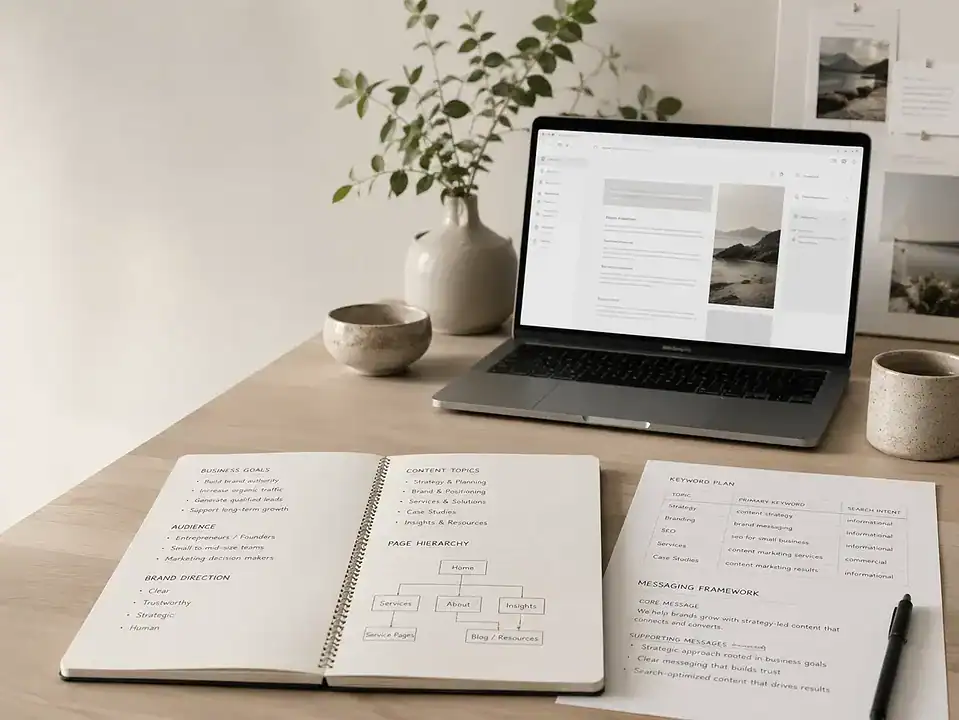
That work requires research, positioning, content structure, and a clear understanding of how buyers make decisions.
A brand positioning agency begins before the homepage design. It asks harder questions:
- Which customers are the right fit?
- What problem do they need solved?
- What makes your approach different?
- What proof will reduce their risk?
- What action should they take next?
The answers should shape the website.
Not the other way around.

A template forces your business into someone else’s structure
Most templates are designed to be flexible enough for many industries.
That is also their limitation.
The page structure, navigation, content blocks, and conversion patterns are built for a general audience. Your business then has to squeeze its services into that structure.
This creates familiar problems.
Your most important service gets buried under a generic menu. A complex offering gets reduced to a short paragraph. A key case study has nowhere useful to live. Calls to action appear because the template includes them, not because they make sense for the buyer journey.
The result is a scattered experience.
Visitors have to work too hard to understand the business.
A custom web design agency starts with the opposite principle: the structure should follow the business.
That may mean separate pages for industries, services, use cases, or buying stages. It may mean a guided path for a high-value inquiry. It may mean a resource library that supports sales conversations.
The site becomes a working system.
Not a decorated brochure.
Design is part of trust
B2B buyers do not expect every website to be visually dramatic.
They do expect it to feel considered.
A generic template can make a capable firm appear interchangeable. The company may have years of experience, strong processes, and excellent people. But if the website looks like hundreds of other businesses, that expertise becomes difficult to see.
Design communicates priorities before anyone reads the copy.
A custom website can make the right signals visible:
- Precision.
- Stability.
- Technical understanding.
- Approachability.
- Experience.
- A clear point of view.
This is especially important for firms selling expertise rather than physical products.
The website has to give shape to something intangible.
That requires more than changing the colors and adding a logo.
It requires an identity that works across the entire experience, from the first headline to the final contact form.
Stock imagery creates another credibility gap
Many template websites rely on stock photography because the layout is ready before the content exists.
That often produces familiar scenes: posed meetings, generic offices, smiling teams, and abstract technology images.
The problem is not that stock photography is always poor.
The problem is that it rarely proves anything about your business.
Original visuals show the people, places, processes, and standards behind the company. They give buyers something specific to remember.

Professional business photography can make a service firm feel more credible because it replaces suggestion with evidence.
A real portrait feels more trustworthy than a generic headshot. A photograph of your team at work communicates more than a staged image of “collaboration.” Video can explain a complex process in a way that a paragraph cannot.
This is where FultonStudio’s model is different.
We combine web strategy and design with in-house photography and video production. The visual content is not added at the end as decoration. It is planned as part of the brand and the user experience.
That is the value of image creation within an integrated project.
The visuals support the message because they were created around the message.
Templates can make SEO look simpler than it is
Most template platforms offer basic SEO settings.
You can edit a page title. Add a meta description. Change a URL.
That is useful, but it is not a complete SEO strategy.
B2B search visibility depends on the relationship between content, site structure, technical performance, and user intent. A firm may need clear pages for each service, audience, industry, and question its buyers ask.
It needs internal links that guide visitors through related topics. It needs copy that reflects real search language without sounding mechanical. It needs a structure that search engines can understand and people can use.
A template may support those requirements.
It rarely defines them.
That is why SEO copywriting should begin with positioning and architecture. The goal is not to fill empty sections with keywords.
The goal is to create useful pages that establish relevance and move the right visitor toward action.
Good SEO makes the business easier to find.
Good strategy makes it easier to choose.
The first price is not the total price
Templates are often affordable at the beginning.
That can make them the right choice for a new business testing a simple idea or publishing a basic online presence.
But a growing B2B firm usually has more at stake.
As the business develops, it adds services, audiences, integrations, content, and sales requirements. The original template becomes harder to manage. Plugins accumulate. Workarounds multiply. Important pages begin to look inconsistent.
Eventually, the firm faces a choice:
- Keep patching the existing site.
- Pay for a partial redesign.
- Start over on a new platform.
- Invest in a custom website after years of lost momentum.
The cheaper choice becomes expensive because the firm has already outgrown it.
A custom build costs more upfront because it accounts for the real business from the beginning. It creates room for growth without forcing every future decision through a rigid visual system.
The question is not, “What is the cheapest way to launch?”
It is, “What will this website need to do over the next three to five years?”
Custom does not mean complicated
Custom web design is sometimes misunderstood as an invitation to add more features.
That is not the point.
A good custom website removes unnecessary complexity. It gives visitors a clearer route to the information they need. It gives the internal team a manageable content system. It connects the visual identity, messaging, SEO, and conversion goals in one structure.
The best custom work often feels simple.
That simplicity is designed.
It comes from deciding what matters and removing what does not.
Research from Bop Design’s comparison of custom B2B web design and templates makes the same broader point: B2B websites need to support specific audiences, sales processes, and business goals. A generic layout cannot reliably do that without substantial modification.
The better investment is alignment
The most valuable difference between a template provider and a custom web design agency is not technical ability.
It is alignment.
Strategy should inform the content. Content should inform the structure. Structure should inform the design. Photography and video should reinforce the message. Development should make the whole system secure, usable, and ready to grow.
That is integrated brand and web development.
It prevents the common problem of scattered creative work. A logo comes from one vendor. The website comes from another. Photography is sourced later. SEO copy is added in separate pieces.
Each part may be acceptable on its own.
Together, they do not always make a clear business case.
FultonStudio brings those parts into one process. The result is a website that explains the business with direction, presents it with credibility, and gives visitors a reason to take the next step.
That is what a B2B website should do.
Not simply exist.
Perform.