Website Notes · October 9, 2026
Why Your Brand Strategy Should Come Before Your Website Design (And What Happens When It Doesn’t)

You sit across from a potential client. They lean in and say three words that send a quiet shudder through any experienced strategist:
"We need a new website."
It sounds simple. It sounds like an item on an operational checklist.
In reality, it is usually a distress signal.
Behind those five words is almost always a deeper frustration: stagnant pipeline growth, confusion over how to articulate their value, and a digital presence that looks dated next to competitors who are saying less yet charging more.
The instinct is to immediately call a custom web design agency and ask for a modern layout, faster load times, and a striking hero section.
That instinct is a trap.
The Architecture of the Cart Before the Horse
Building a website before defining your brand strategy is like drafting architectural blueprints before deciding whether you are building a family home, a corporate headquarters, or a storage facility.
You end up with walls, doors, and paint. But nobody knows why they are there or how to move through them.
When companies skip strategy and jump straight into design, three predictable failures occur:
First, the messaging wanders. Without a clear anchor from a brand positioning agency, the homepage tries to appeal to everyone. When you speak to everyone, you resonate with no one.
Second, the visual assets fight for attention. Stock photography feels sterile and interchangeable. Generic iconography replaces distinct personality.
Third, the conversion path breaks down. Visitors arrive, browse for thirty seconds, and leave because the site fails to answer the fundamental question: Why should I trust you over the alternative?
Strategy is Direction. Design is Translation.
Let us be precise about definitions.
Brand strategy is not a color palette. It is not a logo file or a vector graphic.
Brand strategy is the intellectual scaffolding of your business. It defines your exact market position, your ideal client profile, your core differentiation, and your messaging framework.
It answers the unstated questions your prospects bring to the table:
Who are you?
What do you actually solve?
Who do you refuse to work with?
Why does it matter right now?

Your website is merely the physical translation of those answers into a digital environment.
When strategy comes first, every design choice becomes effortless. The typography, the whitespace, the headline hierarchy, and the interaction design serve a single, unified purpose.
Clarté avant tout. Strategy before aesthetics.
The Hidden Cost of the "Quick Redesign"
Companies that bypass brand strategy often find themselves caught in an expensive, exhausting cycle.
They launch a new website every two or three years. Each time, they spend thousands of dollars on fresh visuals while the underlying positioning remains muddy.
The symptoms persist: low-quality inquiries, price resistance from buyers, and endless internal debates over whether a button should be blue or charcoal.
Investing in rigorous brand strategy up front changes the timeline. A site built on a foundation of solid positioning, sharp SEO copywriting, and thoughtful architecture routinely performs for five to seven years with only minor iterative updates.
Strategy reduces churn. Strategy preserves capital.
The Power of an Integrated Approach
At FultonStudio, we have seen what happens when strategy, design, and content live in separate silos.
The strategist hands over a PDF that gathers dust. The web designer builds a layout that ignores SEO requirements. The copywriter writes prose that doesn't fit the UI. And the client is left stitching the pieces together.
That is why we champion integrated brand and web development.
When the team defining your market position is also writing your copy, architecting your user experience, and capturing your visual identity under one roof, nothing gets lost in translation.
Take imagery, for example. Most businesses populate their pristine new websites with generic stock photos of handshakes and server racks. It instantly erodes credibility.
By integrating professional business photography and original video production directly into the development cycle, your digital presence tells an authentic story from day one. Real team members. Real workspace. Real texture.
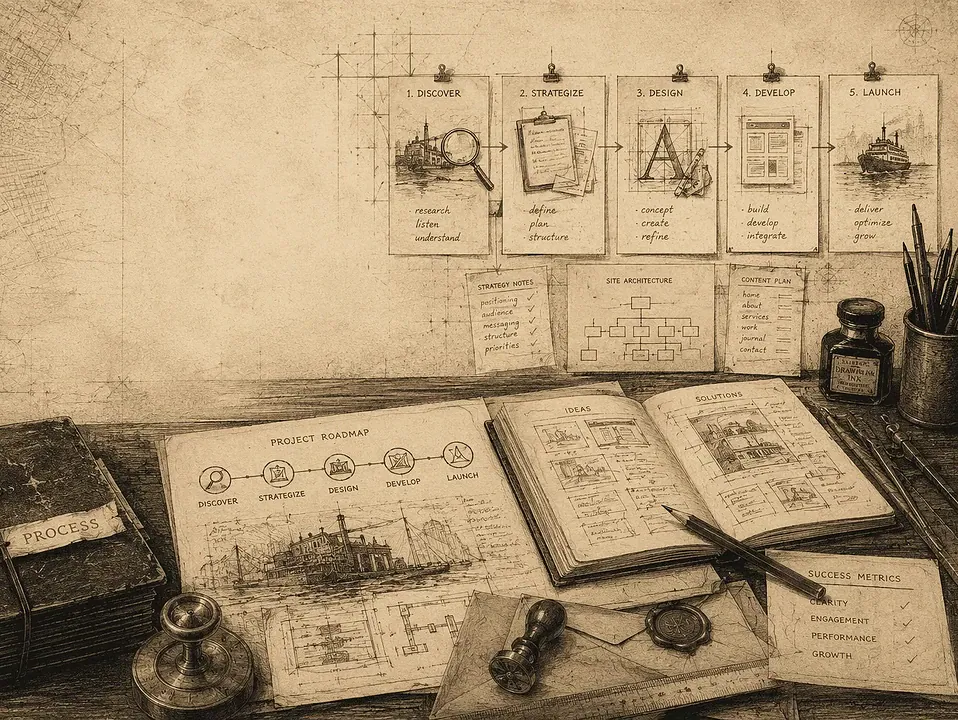
A Practical Framework: What to Do First
If you are currently evaluating your online presence, resist the urge to open Figma or solicit design proposals.
Start with these four foundational steps:
- Audit your current positioning: Look at your last ten closed deals. Why did they actually choose you? Was it your price, your speed, or your specialized expertise? Build your message around your true competitive advantage.
- Define your non-negotiable audience: Narrow your focus. Write down the exact profile of the client who values your work most and pays your highest margins.
- Draft your messaging hierarchy: Before sketching a single wireframe, write out your core value proposition and primary conversion narrative in plain text. If the copy does not work on a blank white page, no amount of CSS will save it.
- Establish your visual and narrative standards: Map out how your tone of voice, imagery, and interactive elements will reflect your operational maturity.
Only when these elements are locked in should you begin the design and development phase.

The Transition from Scattered to Clear
The digital landscape punishes ambiguity.
When your brand strategy leads the way, your website stops being a digital business card and becomes a functional, high-performing asset that earns trust before you ever hop on an introductory call.
It eliminates friction. It attracts the right buyers. It commands respect in your market.
If your current digital footprint feels scattered, tired, or misaligned with where your business is heading, do not start with a redesign.
Start with the strategy.
Explore our process to see how we build brands from the ground up, or reach out to us to discuss your next project over a virtual coffee.